

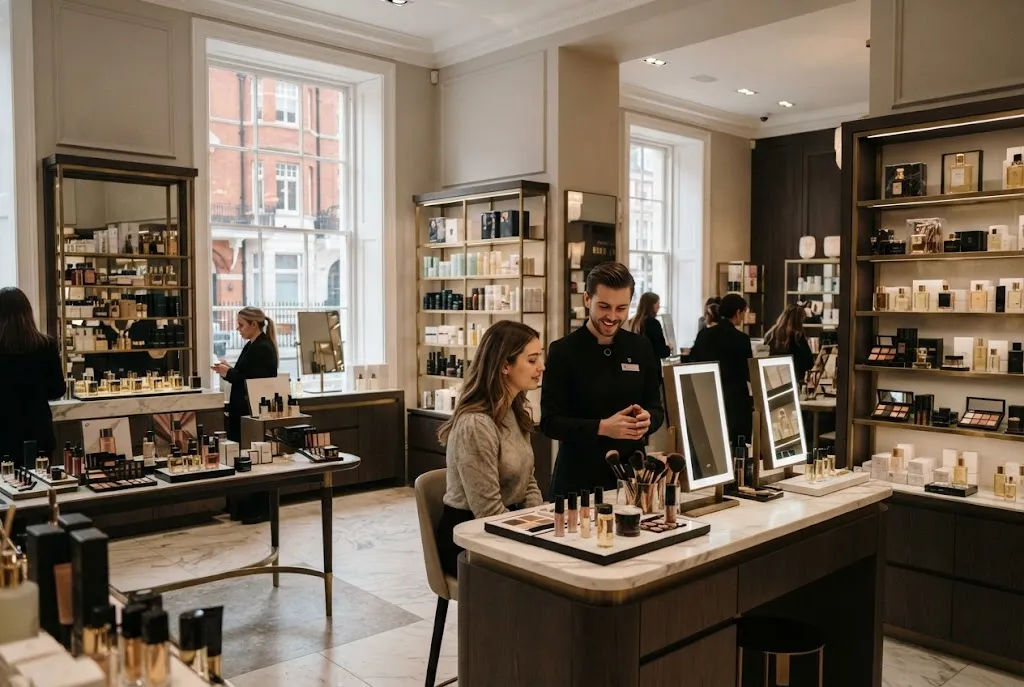
The UK beauty industry is a broad and evolving sector covering cosmetics, skincare, haircare, fragrance, salons, beauty treatments, retailers and specialist businesses. It combines established international brands with independent companies, professional practitioners and online-first businesses. For consumers and businesses alike, understanding how the sector works provides useful context for changing product trends, regulations and purchasing behaviour.
The market is also more complex than a simple list of cosmetic products. Official UK data measures beauty businesses, employment and turnover, while government regulations establish requirements for cosmetic products sold in Great Britain. At the same time, digital commerce, sustainability, premium products and changing consumer expectations continue to influence how the industry develops.
What Is the UK Beauty Industry?
The UK beauty industry includes businesses involved in both beauty products and professional beauty services. Depending on the definition being used, this can include manufacturers, wholesalers, retailers, salons, beauty treatment providers and other businesses connected with personal care.
The Office for National Statistics uses specified UK Standard Industrial Classification categories when producing its dedicated beauty industry data. Its 2025 release examines the count, employment and turnover of VAT and/or PAYE-based enterprises within those defined categories. :contentReference[oaicite:0]{index=0}
This distinction is important because there is no single statistic that captures every business associated with beauty. A cosmetics manufacturer and a local beauty salon operate in different parts of the sector, even though both contribute to the broader beauty economy.
UK Beauty Market: A Diverse Business Landscape
The UK beauty market contains businesses of very different sizes. Large international brands operate alongside independent retailers, specialist product companies, salons, freelancers and small beauty businesses.
ONS data on hairdressing and beauty salons provides a more detailed view of the professional-services side of the market, including enterprise counts, employment, employees and turnover across different UK geographical areas. :contentReference[oaicite:1]{index=1}
This geographic spread matters because beauty services are often closely connected to local demand. A salon’s customer base may be concentrated within a particular town or neighbourhood, while a skincare or cosmetics brand can sell nationally through ecommerce.
As a result, businesses in the same industry can have very different marketing strategies, operating costs and customer acquisition models.
UK Beauty Industry Statistics and Business Activity
Reliable industry statistics help put market discussions into context. The latest dedicated ONS beauty industry release, published in March 2026, covers enterprise counts, employment and turnover for specified beauty-related classifications and UK geographies. :contentReference[oaicite:2]{index=2}
Separate ONS data also examines hairdressing and beauty treatment businesses by turnover size. This allows researchers to understand how enterprises are distributed across different levels of business activity rather than relying on a single industry total. :contentReference[oaicite:3]{index=3}
These figures are useful for business owners, investors, marketers and researchers because they show that the UK beauty economy should be analysed through several measurements.
For a broader statistical perspective, our guide to beauty statistics UK explores industry data, skincare, makeup, consumer behaviour and other key market indicators.
UK Cosmetics Industry and Product Categories
The UK cosmetics industry covers a wide variety of products. Government guidance describes cosmetics as products applied to the skin, hair, lips, teeth or nails, including makeup, perfumes, shampoos, conditioners, skincare products, deodorants, soaps, sun creams and other personal-care products. :contentReference[oaicite:4]{index=4}
This broad definition explains why cosmetic regulation affects such a large range of products. A business may think of itself primarily as a skincare company, for example, while its products still fall within the regulatory framework for cosmetics.
The market can also be divided commercially into categories such as skincare, colour cosmetics, fragrance, haircare and toiletries. Each category has different consumer needs and competitive dynamics.
Beauty Industry Regulations UK Businesses Need to Understand
Beauty industry regulations UK businesses must follow depend partly on the product and where it is being marketed. Great Britain and Northern Ireland should not be treated as having identical cosmetic compliance requirements.
For cosmetic products placed on the Great Britain market, businesses must comply with the applicable UK cosmetics framework. A cosmetic product cannot be placed on the GB market unless it has a Responsible Person established in the UK. :contentReference[oaicite:5]{index=5}
The Responsible Person has important legal responsibilities. These include ensuring product safety requirements are met, maintaining the relevant Product Information File, ensuring appropriate labelling and notifying the product through the required system before it is made available to consumers.
Businesses should therefore consider compliance from the beginning of product development rather than treating regulation as a final administrative step.
UK Cosmetics Regulations: Responsible Person Requirements
The Responsible Person is a central part of the UK’s cosmetics compliance system for Great Britain. According to current government guidance, the Responsible Person can be the manufacturer, importer, an own-brand distributor or an appropriately appointed company or individual. :contentReference[oaicite:6]{index=6}
The Responsible Person must ensure that the cosmetic product is safe and that relevant legal obligations are satisfied. This includes maintaining product information, ensuring required packaging and labelling information is provided, handling notification requirements and being able to support cosmetic claims made in marketing.
For businesses entering the UK market from overseas, determining who will act as the Responsible Person is therefore an important early decision.
Product Information and Labelling
Cosmetic packaging in Great Britain must provide important information such as the Responsible Person’s name and address, product identification details, relevant precautions, weight or volume, applicable dates, country of origin where required and an ingredients list. The information must be presented in English and be easy to read. :contentReference[oaicite:7]{index=7}
These requirements are designed to give consumers information they can use when deciding whether a product is appropriate for them.
Cosmetic Product Notification in Great Britain
Businesses placing cosmetics on the Great Britain market also need to understand the Submit Cosmetic Product Notifications system, commonly referred to as SCPN.
Government information published in July 2026 reported that, as of 28 May 2026, the SCPN system had recorded 861,686 notifications from 24,112 registered Responsible Persons. The system is part of the UK’s approach to monitoring cosmetic products placed on the GB market. :contentReference[oaicite:8]{index=8}
These figures demonstrate the scale of the notification system, although they should not be interpreted as a direct measure of the number of active products or brands currently available to consumers.
Businesses can also use the official SCPN search service to search notified products by product name, category, ingredient or Responsible Person. :contentReference[oaicite:9]{index=9}
Beauty Industry Regulations and Product Safety
Product safety is a fundamental part of the UK cosmetics framework. Before a cosmetic product is made available to consumers in Great Britain, it must be assessed by a qualified professional to confirm its safety. :contentReference[oaicite:10]{index=10}
Responsible Persons also need to understand ingredients and restrictions that apply to cosmetic formulations. Product claims must be supportable, while serious undesirable effects need to be handled through the appropriate reporting process.
The regulatory environment continues to develop. For example, UK legislation published in 2026 introduced amendments concerning certain substances classified as carcinogenic, mutagenic or toxic for reproduction, with one specified amendment applying from 23 March 2027. :contentReference[oaicite:11]{index=11}
This illustrates why businesses should monitor regulatory updates rather than assuming that compliance requirements remain unchanged indefinitely.
UK Beauty Businesses and Digital Commerce
Digital commerce has changed how UK beauty businesses reach consumers. A brand no longer needs a large physical retail network to build an audience across the country.
Websites, online marketplaces, social platforms, email marketing, search engines and creator-led content can all contribute to product discovery. For independent businesses, this can create opportunities to compete through specialist positioning rather than sheer distribution scale.
However, digital visibility also creates greater competition. Consumers can compare prices, ingredients, reviews and product claims quickly. As a result, businesses increasingly need clear product information and useful educational content alongside attractive branding.
UK Beauty Market Trends to Watch
Several themes are influencing the direction of the UK beauty market. They do not affect every category equally, but together they provide useful insight into where the sector is heading.
Sustainability
Environmental concerns continue to influence conversations around packaging, ingredients, waste and product lifecycles. Refillable containers, reduced packaging and responsible sourcing are among the approaches being explored by beauty businesses.
Consumers interested in this topic can read our detailed guide to sustainable beauty for practical information about eco-friendly skincare, packaging and waste reduction.
Premiumisation
Premium and luxury beauty remain important areas of the market. Consumers may be willing to spend more when they perceive meaningful differences in formulation, experience, craftsmanship, brand heritage or service.
Our guide to luxury beauty explores how premium skincare, makeup, fragrance and beauty experiences fit into the changing UK market.
Personalisation
Beauty businesses are also exploring more personalised customer journeys. Recommendations based on preferences, skin concerns and previous purchases can help consumers navigate increasingly crowded product categories.
Digital Discovery
Search engines, social media, reviews and online video continue to influence how consumers discover and evaluate beauty products. This makes content and education increasingly important parts of modern beauty marketing.
UK Beauty Industry Challenges
Despite the opportunities, beauty businesses face several challenges. Competition is intense, product compliance requires careful management, and consumer expectations can change quickly.
Smaller companies may face particular pressure because they must balance product development, inventory, marketing, customer service and regulatory responsibilities with limited resources.
Consumer trust is another important consideration. Beauty products are applied directly to the body, so customers expect accurate information and responsible claims. Businesses that provide clear information can create stronger relationships with informed shoppers.
The Role of Regulation in Consumer Confidence
Regulation can sometimes appear burdensome to businesses, particularly smaller companies entering the cosmetics market. However, clear requirements also help create a framework for consumer protection.
Government guidance allows consumers to check important information such as the identity and address of the Responsible Person, product details and ingredients. :contentReference[oaicite:12]{index=12}
For businesses, compliance can therefore be viewed as part of responsible brand building rather than simply a legal obligation. A company that understands its products, maintains appropriate documentation and communicates accurately is better positioned to build consumer confidence.
UK Beauty Industry Outlook
The outlook for the UK beauty industry is likely to be shaped by a combination of consumer demand, business innovation, regulation and technology.
Established brands will continue to compete for attention while independent businesses can use specialist positioning and direct-to-consumer channels to reach targeted audiences. Professional beauty services will remain closely connected to local economies, while product businesses can increasingly serve customers across the UK and beyond.
Regulation will also remain an important consideration, particularly as authorities continue to monitor cosmetic safety and update applicable requirements.
For businesses, adaptability will be increasingly valuable. Successful companies will need to understand their customers while keeping track of compliance, product development, digital marketing and wider market trends.
How Businesses Can Prepare for the Future
UK beauty businesses can strengthen their position by treating compliance, customer experience and content as connected parts of their strategy.
First, businesses should understand which regulations apply to their products and markets. Second, they should maintain accurate product documentation and labelling. Third, they should communicate product benefits carefully and avoid unsupported claims.
Finally, businesses should pay attention to changing customer expectations. Sustainability, premium experiences, personalisation and digital discovery are not identical trends, but each can influence purchasing decisions.
Final Thoughts on the UK Beauty Industry
The UK beauty industry is a diverse ecosystem that includes products, services, retailers, manufacturers and independent professionals. Its scale can be understood through official business statistics, while its future is being influenced by technology, consumer behaviour, sustainability and changing expectations.
For businesses, understanding the regulatory framework is just as important as understanding customers. Cosmetic products sold in Great Britain must meet specific requirements covering safety, responsible persons, notification, labelling and product information.
For consumers, reliable information makes it easier to evaluate products and businesses with confidence. As the sector continues to develop, the strongest beauty companies are likely to be those that combine product quality with responsible practices, useful information and a clear understanding of what modern UK consumers expect.
