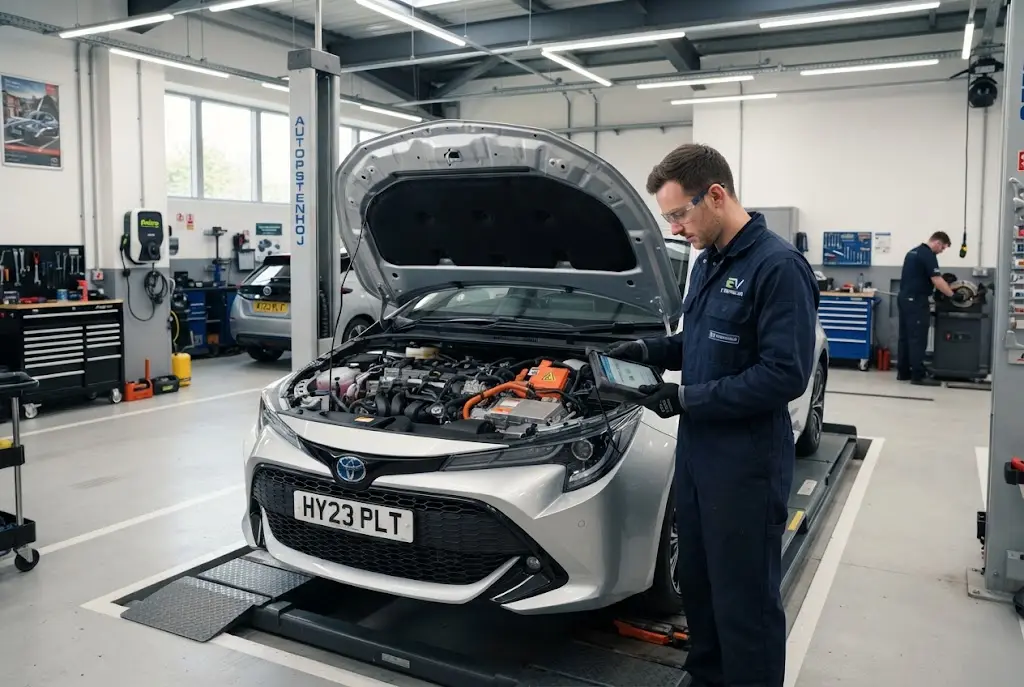
EV servicing is becoming an increasingly important part of vehicle ownership in Britain as more drivers switch from petrol and diesel cars to fully electric vehicles. Electric cars have fewer conventional mechanical components than combustion-engine vehicles, but that does not mean they are maintenance-free. Batteries, high-voltage systems, tyres, brakes, suspension, steering, software and charging equipment all need appropriate attention.
For UK motorists, understanding how electric vehicle maintenance differs from traditional servicing can make it easier to choose a suitable garage and recognise when specialist expertise is required. The right approach also helps owners keep their cars safe, reliable and ready for everyday driving.
Although the exact service schedule varies between manufacturers and models, the basic principle is straightforward: electric vehicles still need regular inspections, even when they do not require the same engine-related maintenance as conventional cars.
What Does EV Servicing Involve?
EV servicing covers a range of inspections and maintenance procedures designed specifically for battery-electric vehicles. The exact work depends on the manufacturer’s recommendations, the vehicle’s age and mileage, and any issues identified during inspection.
A typical electric car service can include checks of the braking system, tyres, steering, suspension, lights, charging equipment, electrical systems and other roadworthiness components. Some vehicles may also receive diagnostic checks and software-related updates as part of their maintenance programme.
The high-voltage battery and associated electrical systems are particularly important. These components should be assessed using the appropriate procedures and equipment rather than treated like an ordinary 12-volt car battery.
Government guidance for MOT testers specifically highlights the additional care required around propulsion batteries and high-voltage components in electric and hybrid vehicles. :contentReference[oaicite:0]{index=0}
Why Electric Vehicle Maintenance Still Matters
One of the biggest misconceptions about electric cars is that having fewer moving parts means owners can ignore servicing. In reality, an EV still has many components that affect safety, comfort and reliability.
Tyres remain particularly important because electric vehicles can be relatively heavy and deliver strong torque from the electric motor. Correct tyre pressure, suitable tread and appropriate replacement tyres should therefore remain part of routine vehicle care.
Brakes also require attention. Regenerative braking can reduce the amount of work performed by conventional friction brakes, but the physical brake components still need inspection. A vehicle that does not use its friction brakes as heavily can still develop issues through age, corrosion or lack of use.
Suspension, steering, wheel alignment, lights, wipers and other roadworthiness items also remain relevant. GOV.UK states that drivers are responsible for ensuring their vehicles remain roadworthy and that having a current MOT does not automatically mean a vehicle is safe to drive. :contentReference[oaicite:1]{index=1}
EV Mechanics Need Specialist Knowledge
Electric vehicles introduce electrical systems that require a different level of workshop knowledge from many traditional vehicles. The UK’s Health and Safety Executive notes that electric and hybrid vehicles can contain significantly higher voltages than conventional 12- or 24-volt vehicle systems, meaning additional skills, training and specialist equipment may be necessary. :contentReference[oaicite:2]{index=2}
This does not mean every task on an EV requires a specialist technician. Routine work such as checking tyres or replacing certain conventional components may be relatively familiar to many automotive workshops.
However, work involving high-voltage systems, propulsion batteries or associated electrical components is different. Drivers should make sure the garage has the appropriate competence before authorising specialist repairs.
Ask About Technician Training
When choosing EV mechanics, motorists should ask whether the workshop has experience working on their specific type of electric vehicle and whether technicians have appropriate training for the work required.
A garage may advertise general EV servicing while having limited experience with a particular manufacturer or complex high-voltage fault. Asking a few questions before booking can help establish whether the workshop is suitable.
This becomes particularly important when a repair involves battery diagnostics, high-voltage isolation or other work that goes beyond ordinary mechanical maintenance.
Battery Servicing and Battery Health
The traction battery is one of the most important components in an electric vehicle. It stores the energy used to power the electric drivetrain, making battery condition central to the car’s range and performance.
Battery servicing does not necessarily mean opening the battery pack or replacing individual cells. In many cases, maintenance involves monitoring the vehicle’s battery-management systems, checking relevant electrical components and identifying faults through diagnostic equipment.
Modern battery systems use electronic management systems to monitor and control battery operation. Government guidance on lithium-ion battery systems highlights the importance of battery-management systems in monitoring battery condition, state of charge and other important parameters. :contentReference[oaicite:3]{index=3}
For EV owners, this reinforces the importance of using appropriate diagnostic procedures rather than attempting to investigate high-voltage battery problems without the necessary expertise.
What Happens During Battery Servicing?
The exact process depends on the manufacturer and vehicle. A workshop may perform diagnostic checks, inspect relevant cables and connectors, examine cooling arrangements where applicable and assess available battery-health information.
Some manufacturers and specialist providers can provide a battery health report. Such information can be particularly useful when buying or selling a used electric vehicle because battery condition can be an important part of the car’s overall value and usability.
However, motorists should be cautious about universal battery-health percentages or generic claims. Battery systems differ between vehicles, so results should be interpreted according to the manufacturer’s specifications and the diagnostic method being used.
Charging Infrastructure and EV Maintenance
Charging infrastructure is another part of electric vehicle ownership that does not have a direct equivalent in traditional petrol and diesel motoring.
Drivers may use home charging equipment, workplace chargers or public charging networks. Although the charging point itself may not be part of a routine vehicle service, the vehicle’s charging port, cables and related systems can require inspection if problems occur.
Charging faults should not automatically be assumed to be caused by the battery. Problems can involve the charging cable, vehicle connection, charging hardware, software or external charging infrastructure.
A qualified technician can help identify whether the fault is within the vehicle or originates elsewhere. This can prevent unnecessary repairs and make troubleshooting more efficient.
Software Updates Are Part of Modern EV Ownership
Electric vehicles are increasingly software-driven. Electronic control systems influence battery management, charging, driving behaviour and other vehicle functions.
As a result, software updates can form part of maintaining a modern EV. Depending on the manufacturer, updates may be installed remotely or during a workshop visit.
Owners should follow the manufacturer’s instructions for software updates and pay attention to service notifications. If an EV develops an unusual electronic issue, a diagnostic scan may be an important first step before replacing physical components.
EV Servicing and Tyre Wear
Tyres deserve particular attention during EV servicing. Electric vehicles can have substantial weight from their battery packs, while instant electric-motor torque can influence how the car accelerates.
Tyre pressure should be maintained according to the vehicle manufacturer’s recommendations. Drivers should also inspect tread condition and look for cuts, bulges or unusual wear.
Uneven wear can sometimes indicate issues with wheel alignment, suspension or steering rather than simply an old tyre. If a vehicle is showing unusual wear patterns, the cause should be investigated before replacement tyres are fitted.
Our wider guide to wheel alignment explores why correct steering and wheel geometry matter for vehicle stability, tyre wear and road safety.
Do Electric Cars Need Brake Servicing?
Yes. Although regenerative braking can reduce reliance on conventional friction brakes, electric vehicles still have mechanical braking systems that require inspection.
Brake discs, pads, callipers and related components can deteriorate through age, corrosion or other factors. Drivers should not assume that low brake-pad wear means the entire braking system can be ignored.
During routine maintenance, a technician can assess the condition of the braking system and identify whether cleaning, adjustment, replacement or further investigation is appropriate.
How Often Should an EV Be Serviced?
There is no single servicing interval that applies to every electric vehicle. Manufacturers set their own maintenance schedules, which can depend on model, age, mileage and operating conditions.
The owner’s handbook or official manufacturer service information should therefore be treated as the primary reference.
Drivers should also distinguish between servicing and day-to-day checks. Even if a vehicle’s formal service interval is relatively long, owners still need to monitor tyres, lights, brakes, warning messages and other safety-related items between appointments.
GOV.UK recommends checking basic vehicle safety items regularly and states that the vehicle handbook will provide information about servicing requirements. :contentReference[oaicite:4]{index=4}
Choosing a Garage for EV Servicing
Choosing a suitable workshop is one of the most important decisions for an electric vehicle owner. The cheapest service is not necessarily the best choice if the garage lacks appropriate EV knowledge or equipment.
Start by asking whether the workshop regularly works on electric vehicles. If the required work involves high-voltage components, confirm that the technicians are appropriately trained and that the workshop follows suitable safety procedures.
It is also useful to ask what the service includes. A quotation should make clear which checks will be performed and whether diagnostic work, software updates or additional inspections are included.
Drivers comparing different types of workshops can also read our guide to automotive service companies for a broader comparison of independent garages, national workshops and regional automotive businesses.
Manufacturer Dealer or Independent EV Garage?
Electric vehicle owners are not necessarily limited to manufacturer dealerships. Independent garages and national automotive networks may also offer EV-related services.
The important consideration is capability. A workshop should have suitable equipment, trained technicians and access to reliable vehicle-specific information.
Manufacturer dealerships may be particularly useful for warranty-related work, manufacturer-specific diagnostics, software issues or repairs requiring proprietary equipment. An experienced independent EV specialist, meanwhile, may offer a practical alternative for routine maintenance and certain repairs.
Before choosing either option, motorists should check what work the workshop is qualified and equipped to undertake.
Warning Signs That an EV Needs Attention
Electric cars can display warnings or symptoms that deserve prompt investigation. These may include battery-related alerts, charging problems, unusual noises, reduced performance or unexpected changes in range.
A warning message should not automatically be interpreted as evidence of a failing battery. Modern EVs contain numerous electronic systems, and a diagnostic assessment may be needed to identify the actual cause.
Drivers should follow the vehicle manufacturer’s instructions when warning messages appear. If a fault affects the vehicle’s ability to operate safely, it should not simply be ignored until the next routine service.
EV Servicing and the Future of Transport
The growth of electric vehicles is changing Britain’s automotive service industry. Traditional mechanical skills remain important, but workshops increasingly need knowledge of high-voltage electrical systems, battery technology, electronic diagnostics and software.
This shift also creates opportunities for specialist EV mechanics and automotive businesses that invest in appropriate training and equipment.
For motorists, the expanding service network should make electric vehicle maintenance increasingly accessible. At the same time, the technical complexity of EV systems means drivers should remain selective about who works on high-voltage components.
Cleaner Mobility Requires Good Maintenance
Electric vehicles are an important part of the wider move towards cleaner mobility, but owning an EV does not remove the need for responsible vehicle care.
Maintaining tyres, brakes, steering and suspension helps preserve safety, while appropriate battery and electrical-system checks can help identify problems before they become more serious.
Good maintenance also supports reliable everyday transport. A well-maintained electric vehicle is better positioned to deliver the performance, efficiency and convenience that owners expect from modern electric motoring.
Final Thoughts on EV Servicing
EV servicing is different from conventional car servicing, but it is not something electric vehicle owners should find intimidating. The key is understanding which components need regular attention and making sure specialist work is carried out by appropriately trained professionals.
Tyres, brakes, steering, suspension and other familiar safety systems remain important, while battery health, charging equipment, high-voltage components and software add new considerations.
As Britain’s electric vehicle network continues to develop, drivers have more choices when selecting a workshop. The strongest choice is one that matches the vehicle and required work with the right technical capability, equipment and safety procedures.
For anyone considering an electric vehicle, regular maintenance should be viewed as part of ownership from the beginning. Good EV servicing can support safety, reliability and confidence as electric motoring becomes a more familiar part of British life.